

What is a Minimum Spanning Forest?
- For a connected graph, the MSF is a single minimum spanning tree (MST) that connects all nodes with the minimum total edge weight
- For a disconnected graph, the MSF consists of multiple MSTs, one for each connected component
- The forest contains no cycles and has exactly
N - Cedges, whereNis the number of nodes andCis the number of connected components - The sum of the weights of the edges in the forest is minimized
Use Cases
- Network Design: Minimize cable/pipeline costs when connecting multiple locations
- Clustering: Identify natural groupings in data by analyzing the forest structure
- Image Segmentation: Group similar pixels using edge weights as similarity measures
- Road Networks: Optimize road construction to connect all cities with minimum cost
Syntax
Parameters
The procedure accepts an optional configurationMap with the following optional parameters:
Return Values
The procedure returns a stream of records corresponding to each tree in the forest with the following fields:Create the Graph
Examples:
Suppose you are an urban planner tasked with designing a new transportation network for a town. There are several vital buildings that must be connected by this new network. A cost estimator has already provided you with the estimated cost for some of the potential routes between these buildings. Your goal is to connect every major building with the lowest total cost, even if travel between some buildings requires multiple stops and different modes of transport. The Minimum Spanning Forest algorithm helps you achieve this by identifying the most cost-effective network.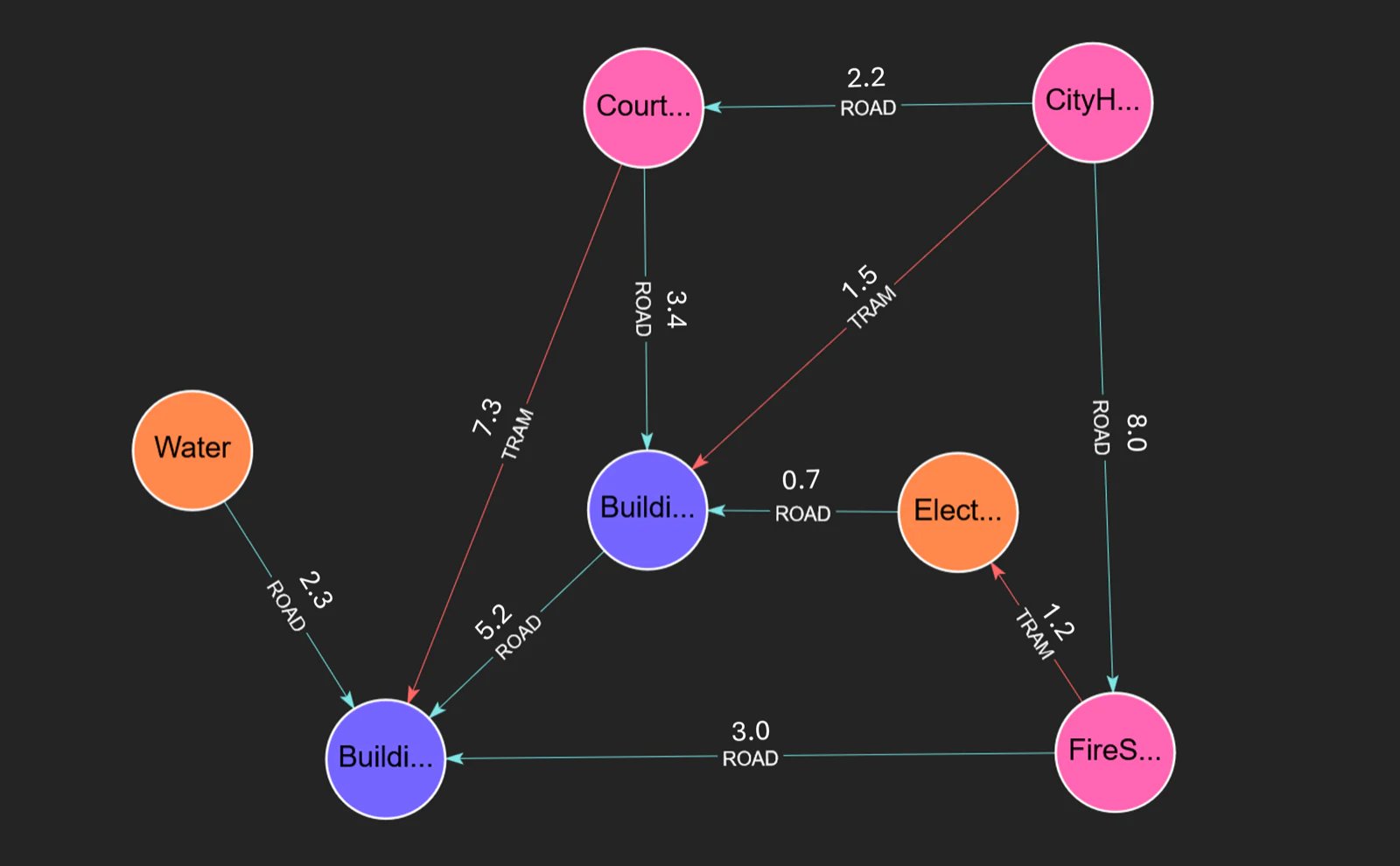
Expected Results
The algorithm would yield a single tree containing the following edge and node objects: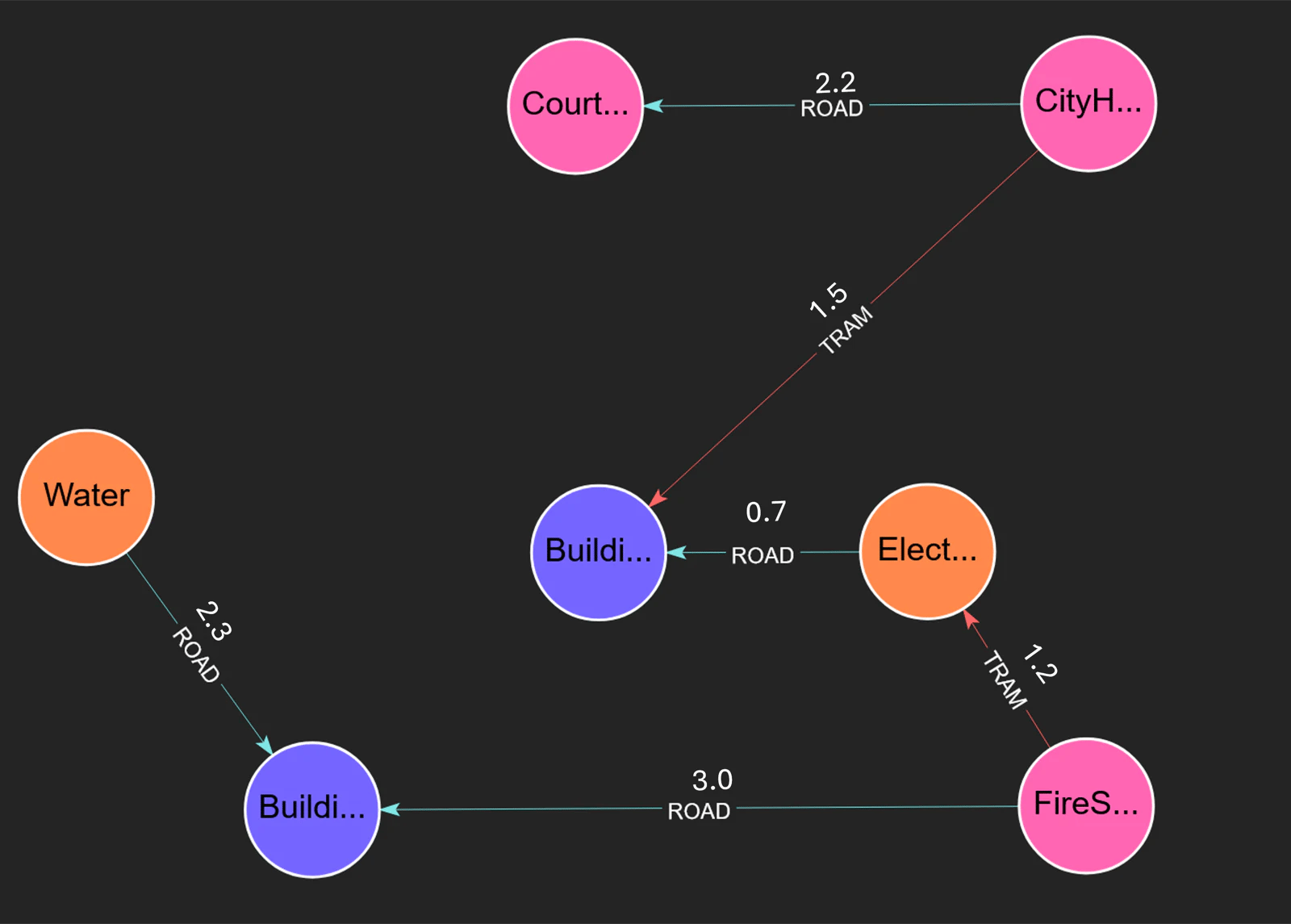
Algorithm Details
FalkorDB’s MSF implementation uses an efficient matrix-based approach optimized for graph databases:- Connected Components: First identifies all connected components in the graph
- MST per Component: Computes a minimum spanning tree for each component using a variant of Kruskal’s or Prim’s algorithm
- Edge Selection: Selects edges in order of increasing weight, avoiding cycles
Performance Characteristics
- Time Complexity: O(E log V) where E is the number of edges and V is the number of vertices
- Space Complexity: O(V + E)
- Optimized: Uses sparse matrix representation for efficient computation
Best Practices
- Weight Properties: Ensure weight properties are numeric (integers or floats)
- Missing Weights: Edges without the specified weight property will only be included in the tree if there are no other edges that could be used to connect the connected component
- Directed vs Undirected: The algorithm treats all relationships as undirected for spanning forest purposes
Related Algorithms
- WCC (Weakly Connected Components): Identify connected components before running MSF
- BFS: Traverse the resulting spanning forest
- SPpath: Find shortest paths using the spanning forest structure
See Also
Frequently Asked Questions
What is the syntax for calling the MSF algorithm?
What is the syntax for calling the MSF algorithm?
Use
CALL algo.MSF({weightAttribute: 'cost'}) YIELD edges, nodes with an optional configuration map. All parameters are optional.Can I compute a Maximum Spanning Forest instead of minimum?
Can I compute a Maximum Spanning Forest instead of minimum?
Yes. Set
objective: 'maximize' in the configuration map to find the spanning forest with the maximum total edge weight.How does MSF handle disconnected graphs?
How does MSF handle disconnected graphs?
MSF returns a separate spanning tree for each connected component. The result is a forest — a collection of trees, one per component.
What happens to edges without the specified weight property?
What happens to edges without the specified weight property?
Edges missing the weight property are only included if no other edges can connect the component. It is best practice to ensure all relevant edges have numeric weight values.
When should I use MSF vs WCC?
When should I use MSF vs WCC?
Use WCC to simply identify connected components. Use MSF when you need the optimal set of edges connecting all nodes within each component at minimum (or maximum) cost.