> ## Documentation Index
> Fetch the complete documentation index at: https://docs.falkordb.com/llms.txt
> Use this file to discover all available pages before exploring further.
> ## Agent Instructions
> FalkorDB is a graph database that speaks the Redis protocol. Queries are issued as OpenCypher through the GRAPH.QUERY and GRAPH.RO_QUERY commands, not over Bolt or a SQL connection.
> FalkorDB implements a subset of OpenCypher with proprietary extensions. Do not assume Neo4j-only syntax or procedures are available — check /cypher/cypher-support and /cypher/known-limitations before using a clause.
> FalkorDB is the successor to RedisGraph, but they are separate products. Do not present RedisGraph commands, versions, or limitations as current FalkorDB behavior.
> Use the official clients listed in /getting-started/clients rather than generic Redis or Neo4j drivers, and prefer the language the user is already working in.
> Configuration parameters are set with GRAPH.CONFIG SET or at startup; cite the exact parameter name from /getting-started/configuration rather than inventing one.
> This site covers four products: FalkorDB (core), FalkorDB Cloud, FalkorDB Enterprise, and the GraphRAG SDK. Name which one an answer applies to, since setup and operations differ.
# Query History
> Persistent local query history: open dialog, search/filter by graph, view metadata, delete queries.
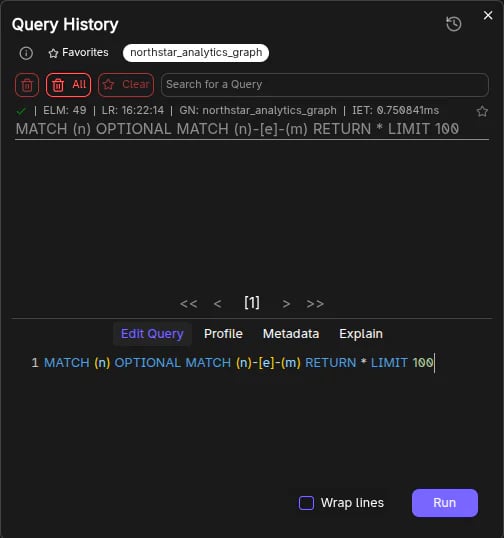
Query History stores previously executed queries in the browser (localStorage) and exposes a dialog to browse them.
 ## Opening Query History
Click the history button (clock icon) in the selector bar.
If there are no saved queries, the button is disabled.
## What you can do
Inside the Query History dialog:
* **Search** previous queries.
* **Filter by graph name** (toggle one or more graphs).
* **Select a query** to load it into the history editor.
* **View per-query tabs**:
* Edit Query
* Profile
* Metadata
* Explain
## Deleting history
The dialog supports:
* Delete selected queries (supports multi-select via Ctrl + right-click)
* Delete all queries
Persistence notes:
* Stored under localStorage key: `query history`.
## Frequently Asked Questions
Query history is stored in your browser's **localStorage** under the key `query history`. It persists across sessions but is local to your browser.
Click the **history button** (clock icon) in the selector bar above the query editor. The button is disabled if no queries have been saved yet.
Yes. In the Query History dialog, use **Ctrl + right-click** to multi-select queries, then delete the selected ones. You can also delete all queries at once.
Yes. The dialog includes a **filter by graph name** option that lets you toggle one or more graphs to narrow down the displayed queries.
## Opening Query History
Click the history button (clock icon) in the selector bar.
If there are no saved queries, the button is disabled.
## What you can do
Inside the Query History dialog:
* **Search** previous queries.
* **Filter by graph name** (toggle one or more graphs).
* **Select a query** to load it into the history editor.
* **View per-query tabs**:
* Edit Query
* Profile
* Metadata
* Explain
## Deleting history
The dialog supports:
* Delete selected queries (supports multi-select via Ctrl + right-click)
* Delete all queries
Persistence notes:
* Stored under localStorage key: `query history`.
## Frequently Asked Questions
Query history is stored in your browser's **localStorage** under the key `query history`. It persists across sessions but is local to your browser.
Click the **history button** (clock icon) in the selector bar above the query editor. The button is disabled if no queries have been saved yet.
Yes. In the Query History dialog, use **Ctrl + right-click** to multi-select queries, then delete the selected ones. You can also delete all queries at once.
Yes. The dialog includes a **filter by graph name** option that lets you toggle one or more graphs to narrow down the displayed queries.